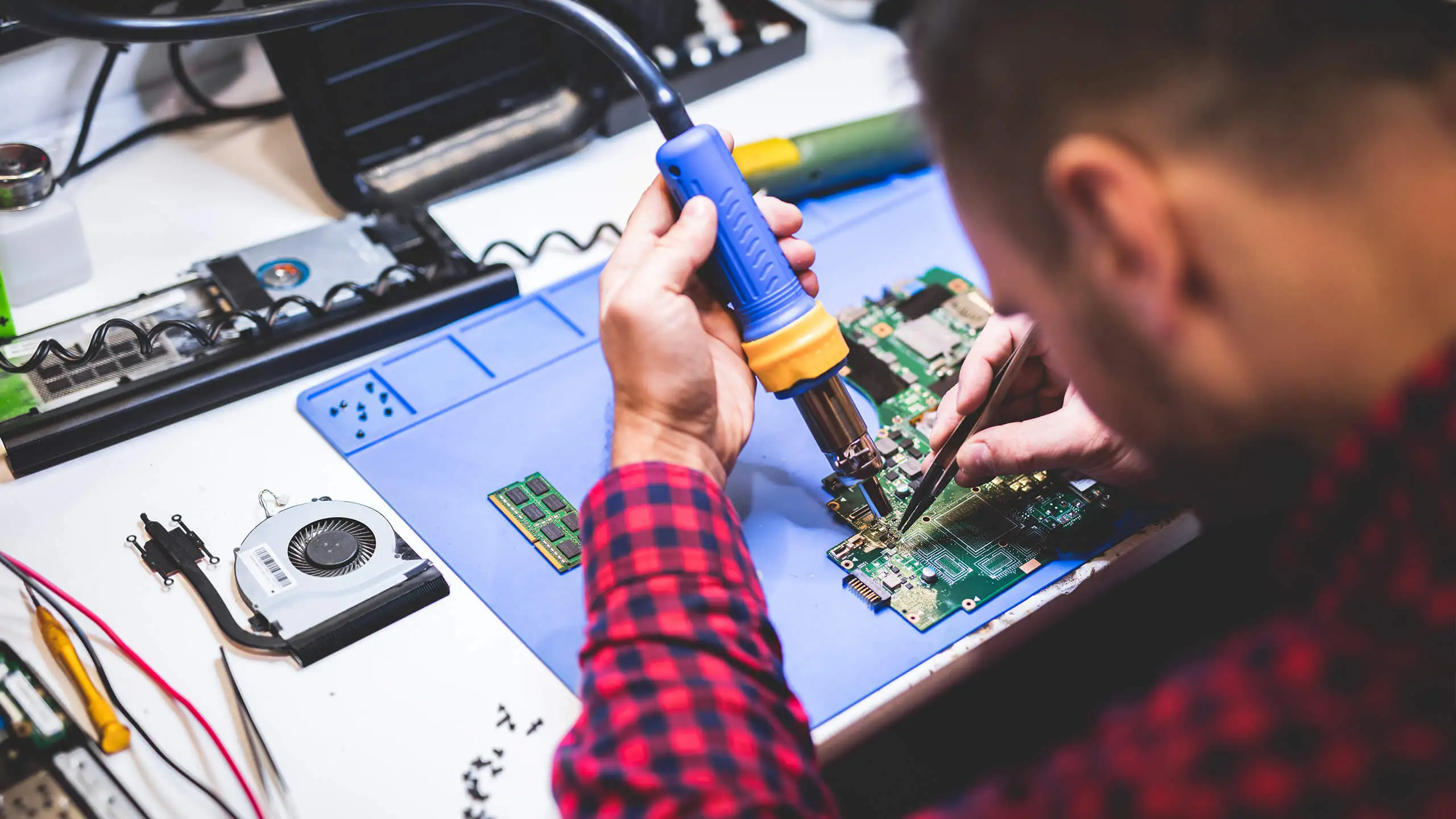
Electronics are everywhere: smartphones, laptops, televisions, automotive control units, household appliances, industrial equipment and automation systems. When a device fails, replacing it is not always necessary. In many cases, the fault can be diagnosed and repaired.
Where does a repair begin?
Professional electronics repair starts not with a soldering iron, but with diagnostics. A technician examines the symptoms, inspects the device and checks its power supply, connectors, fuses and major electronic components.
For more advanced diagnostics, technicians use multimeters, laboratory power supplies, oscilloscopes, signal generators, programmers and other measuring equipment. Circuit diagrams and technical documentation may also be required.
Once the fault has been identified, the defective component can be repaired or replaced. It may be a capacitor, transistor, diode, voltage regulator, integrated circuit, connector or even a damaged section of the printed circuit board.
Who repairs electronics?
Electronics repair combines several technical disciplines. It may be performed by electronics technicians, radio technicians, electronics engineers, service engineers and microelectronics specialists.
Knowing how to solder is no longer enough. A modern technician needs an understanding of electronic circuits, analog and digital electronics, power supplies, microcontrollers and software.
Why is modern electronics repair becoming more complicated?
Electronic devices are becoming increasingly compact. They use SMD components, multilayer PCBs and complex integrated circuits. Some faults cannot be detected with the naked eye.
Technicians therefore rely on soldering stations, hot-air equipment, microscopes and specialized tools.
Software-related repair is another important area. It includes firmware recovery, microcontroller programming, electronic module configuration and working with device memory.
Repair or replace?
The answer depends on the value of the device and the type of failure. Replacing a single electronic component can cost considerably less than purchasing new equipment.
Repair is particularly worthwhile for expensive devices, professional equipment, automotive electronics and products that are no longer manufactured.
Electronics repair therefore remains an important technical profession. As the number of electronic devices around us continues to grow, so does the need for specialists who can diagnose failures and bring equipment back to life.